Book7 Slider

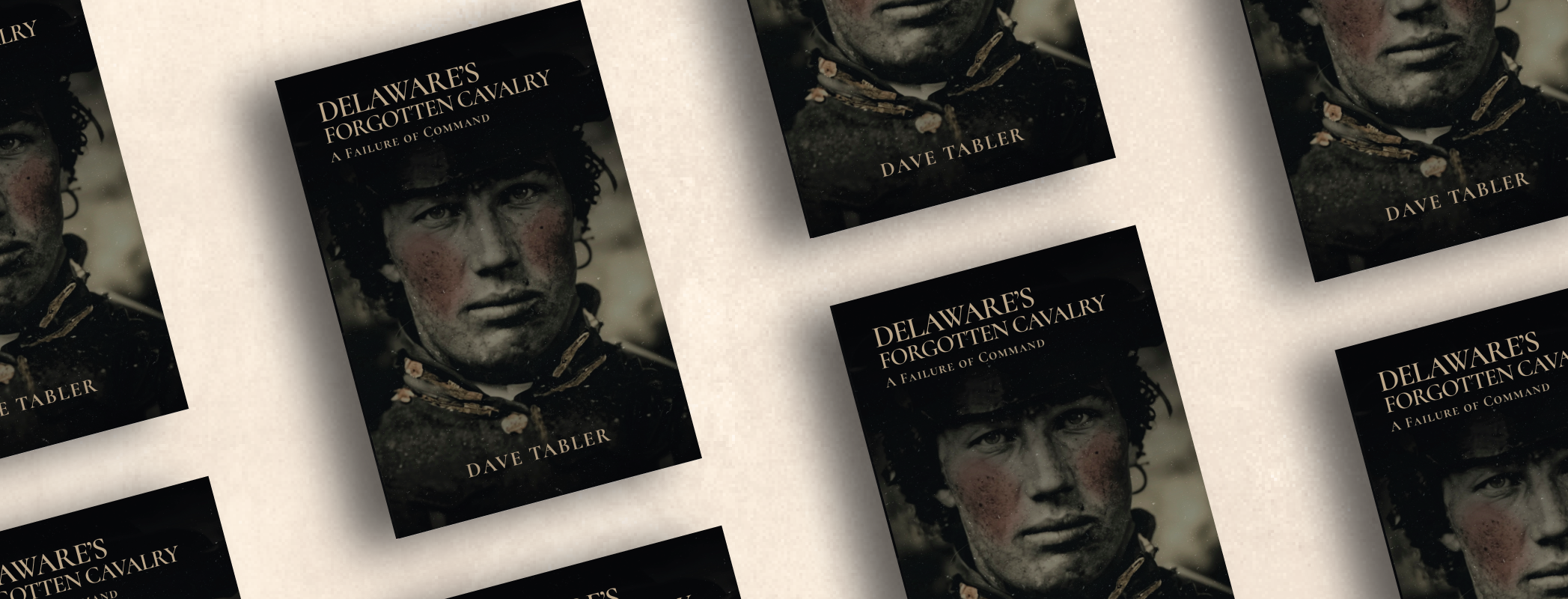
Delaware’s Forgotten Cavalry

A Failure of Command
Release Date: January 1, 2027

In June 1863, a small cavalry unit from Delaware faced off against Confederate legend J.E.B. Stuart in a desperate charge at Westminster, Maryland. What happened next should have made them heroes. Instead, their story was systematically buried by the very man who was supposed to lead them.

Major Napoleon Bonaparte Knight was a political appointee with no military experience—a Confederate deserter who took a Union commission when the winds shifted. When his cowardice at Westminster threatened to become a scandal, courts-martial were quashed. Witnesses were silenced. Official reports were rewritten.

BUT THREE SERGEANTS KEPT DIARIES.

For 160 years, these firsthand accounts have sat in separate archives, telling pieces of a story that Civil War historians have never assembled. By weaving together the daily entries of Harrison Vandegrift, Spencer Hitch, and Townsend Downes with official records and personal correspondence, Delaware’s Forgotten Cavalry reveals how ordinary soldiers responded when their leadership failed catastrophically, and how they quietly chose honor over hierarchy.

The cover-up had powerful allies in Washington. The truth had three sergeants with diaries. Their voices, preserved in fading ink and scattered collections, endure to this day.

Some stories survive because they’re too important to stay buried.

More to Know

Editorial Reviews

Read the full review by BlueInk Review

An uncensored Civil War portrait of flawed leadership and fierce loyalty, Dave Tabler’s book  aims to correct the historical record on the composure, competence, and bravery of the First  Delaware Cavalry and direct the spotlight where it belongs: on the shameful actions and  inactions of its commanding officer.  

Three sergeants from that division— Harrison Vandegrift, Spencer Hitch, and William Townsend  Downes— had the incredible presence of mind to record their time of service, scribbling down  scattered thoughts, troop movements, observations and feelings about their commanders.  These unedited diary entries, along with contextual exposition, maps, and footnotesprovide a rare glimpse into the minutiae of daily existence during the final full year of that terrible  conflict. From the monotony of unexpected maneuvers to the terror of sudden shellings, the  book is a grim reminder that time marches inexorably on—to the next valley, campsite, or  bloody battlefield.  

Specifically, the story focuses on the events of 1864, the year of Major Napoleon Bonaparte  Knight’s court-martial proceedings, and his continued disdain and endangerment of the  sergeants and soldiers in his ranks. The book makes clear that the often-soused but well connected major of the First Delaware repeatedly failed to lead, equip, organize, or protect the  men under his command.  

The three sharply distinct voices provide a multi-faceted perspective: one a bit uncouth but  honest, a second meticulous and observant, and a third reflective, with a broader view on the  microcosmic plod of events. The author’s commitment to telling the story in these men’s words  is admirable, and the narrative is instantly immersive, offering a visceral sensation of the  soldiers’ endless routine, exhaustion and anxiety.  

For readability’s sake, however, and to give the underlying story arc a more coherent shape,  some editing of entries or redundant content would be welcome.  

That said, whether you’re a Civil War buff or a fan of Delaware’s hidden histories, this is a  uniquely crafted record of a story that deserves to be remembered.

Book reviewed in July 2026.

Read the full review by BookLife

In this detailed blend of diary entries and historical record, historian Tabler (author of Delaware Keepers) gives his main characters—Civil War Union sergeants Harrison Vandegrift, Spencer Hitch, and William Townsend Downes—the space to express the untold story of the First Delaware Cavalry in their own words. In June 1863, this Union battalion was skirmished by Confederate soldiers. Their commander, Major Napoleon Bonaparte Knight, stayed behind rather than joining the advance, leading to an uncoordinated battalion clash that resulted in several wounded—and some killed—Union soldiers. As the story unfolds, Tabler examines Knight’s actions and reports of his erratic behavior, frequent drunkenness, and “shirking duty under false pretenses,” ultimately suggesting that Knight was appointed due to his powerful political connections more so than his competence.

The majority of Tabler’s account consists of diary logs from Vandegrift, Hitch, and Downes, showcasing the thoughts of real men faced with the daily problems typical of an American Civil War soldier. “A man… soon learns to appreciate home and despise war,” Vandegrift declares, documenting the constant death, disease, and discomfort of his surroundings. The days stretch on, many with “nothing of any interest Going on Here,” as Downes notes, but tension builds as legal charges against Knight—and a general feeling of contempt—start to mount. Through court records, newspaper excerpts, offhand mentions, and more, readers piece together Knight’s fate—and how Delaware’s history of being a “political battleground territory” contributed to it.

The diaries, reproduced with original syntax and spelling, paint a portrait of the men’s everyday personalities. Some entries and shorthand can be hard to decipher, and comprehensive summaries at chapter headings curb the suspense, but Tabler successfully illuminates the quiet humanity in men facing an unstable leader and a grueling war, adding context with maps, photographs, and footnotes. Readers seeking the stories that have fallen through the cracks of historical records will relish this narrative.

Takeaway: Authentic portrayal of Civil War soldiers’ reaction to failing leadership.

Great for fans of: Daniel Murphy’s Horse Soldiers at Gettysburg, Will Gorenfeld and John Gorenfeld’s Kearny’s Dragoons Out West.

Production grades
Cover: B+
Design and typography: B-
Illustrations: B+
Editing: B
Marketing copy: B+

Read the Review Website Here

Read the full review by Forward Reviews

Tracing a lieutenant colonel’s failure during a Civil War battle and subsequent downfall through the eyes of the soldiers beneath him, Delaware’s Forgotten Cavalry is an insightful historical resource.

Dave Tabler’s revealing history text Delaware’s Forgotten Cavalry focuses on enlisted soldiers for the Union and a crisis in command they faced.

Covering a period of eighteen months, this history of the First Delaware Cavalry relies on the diaries of three company sergeants who recorded both quotidian details and their growing unease with their commander, Lieutenant Colonel Napoleon Bonaparte Knight. Knight’s “martial skills did not match the legacy of his impressive name,” they suggest. On June 29, 1863, during a battle in Westminster, Maryland, Knight’s desultory leadership style came to greater light: He remained in the rear while ordering junior officers to charge the Confederate cavalry. After the debacle, Knight—a man with no military experience but plenty of political patronage—tried to paint himself as in control during the battle, despite evidence to the contrary.

Daily accounts follow, from January 1 to December 8, 1864. A new campaign began after the battle—one of “reputation, rumor, and retribution.” Knight’s erratic behaviors, as well as his manipulations of the men under his command, are fleshed out well, setting the stage for the voices of the diarists that follow. All leads to formal charges and Knight’s dismissal from military service.

The book’s opening chapters of historical narrative are used to contextualize the major events faced by the First Delaware Cavalry in 1863, including the Westminster battle. The sergeants’ “triangulation” of working-class perspectives—those of farmers and merchants of varying degrees of education—places the units’ actions, and the “smaller dramas of character and consequence,” into nuanced context. Still, the men’s preserved spelling and punctuation errors sometimes slow the book’s flow.

Each chapter begins with an overview of the cavalry’s situation at the time, with ample footnotes illuminating the more arcane details not explained in the diary entries themselves. In part, these build momentum toward Knight’s downfall, with numerous notations by the sergeants of the officer’s drunken escapades and unexplained absences included; however, the entries themselves often do not reveal as much as the historical record does. When Knight is mentioned in the entries themselves, the men’s revelations are comparatively muted. The mortar that pulls the story together are the situation briefs at the beginning of each chapter, the footnotes that fill in the gaps, and the book’s afterword, which glimpses at the postwar lives of the diarists too.

Delaware’s Forgotten Cavalry is a rich history text about one Union regiment’s crisis of authority after a failure in the field.

Reviewed by Peggy Kurkowski

View the Review Website

Read the full review by Kirkus

A fascinating, nuanced, bottom-up history of one of the Civil War’s lesser-known battalions.

Tabler chronicles the Civil War experiences of the First Delaware Cavalry in this grassroots history.

One of the Civil War’s more unheralded battalions, the First Delaware Cavalry, is perhaps best known for its contributions to the Union’s Gettysburg campaign and for its notoriously poor leadership under Major Napoleon Bonaparte Knight. A young, inexperienced leader with virtually no prior combat experience, Knight is portrayed in this volume as a drunkard and ineffective opportunist who had initially sought to join the Confederacy but secured his position with the Union “through political patronage rather than military competence” as the son of a wealthy farmer. Indeed, Knight was entirely absent from the battalion’s best-known battle at Westminster, Maryland. Many historians believe that the skirmish (called Corbit’s Charge after Captain Corbit, who look the reins after Knight was found missing), though a loss for the Union, would ultimately contribute to the defeat of the Confederates at Gettysburg days later by slowing the advance of General J.E.B. Stuart. While Knight’s actions serve to drive the book’s timeline, what makes this work special is its emphasis on the perspectives of three of his sergeants—Harrison Vandegrift, Townsend Downes, and Spencer Hitch—who preserved their thoughts in daily diaries. An unmarried farmer, Vandegrift was moderately educated and spent his spare time reading novels, and Downes had a keen understanding of the military’s bureaucratic details as a middle-class merchant. Hitch was the least educated of the trio, and his diary is the most unfiltered. He writes about a myriad of topics—from the weather to personal grievances—in entries replete with grammatical and spelling errors. While their backgrounds and points of view are individually distinct, all three were deeply critical of Knight, and, per Tabler, their accounts tell a story of “moral courage” despite the First Delaware Cavalry’s “institutional failure.”

The diary entries are transcribed in the book, presented in an unedited format that makes for an immersive, authentic read under the careful editorial oversight of Tabler, who provides commentary and clarification in footnotes when needed. The entries offer fascinating insights into the lives of 19th-century soldiers, and the book compellingly explores the ways in which the sergeants maintained their personal courage despite Knight’s weak leadership. The author expresses admiration for the First Delaware Cavalry’s rank and file as the men navigated their precarious situation, but he doesn’t attempt to hide their shortcomings. Hitch’s entries, for instance, frequently contain racial slurs aimed at Black Americans, and Downes, per Tabler, sometimes took a “more openly punitive tone” when discussing the alleged crimes of Black Americans he encountered. As the author of multiple previous works on Delaware’s history, Tabler has a firm grasp on the state’s unique history as a border state where slavery remained legal despite its participation in the war on behalf of the Union. The volume’s 15 chapters are all supported by citations that reference both academic publications and primary sources that extend beyond the core three diaries and include material from a host of archival repositories. The well-researched, engagingly written text is supplemented by visual elements that include maps, photographs, paintings, and engravings. A fascinating, nuanced, bottom-up history of one of the Civil War’s lesser-known battalions.

View the Review Website

Read the full review by Midwest Book Review

Delaware’s Forgotten Cavalry: A Failure of Command is based on the pocket diaries kept by three sergeants of the First Delaware Cavalry — Harrison Vandegrift, Spencer Hitch, and William Townsend Downes — who documented the 1864 war they were living through. These rare writings are some of the few to detail events and circumstances that evolved from Delaware’s cavalry, whose involvement was largely rewritten to suit the political perceptions of political appointee Colonel Napoleon Bonaparte Knight.

That author Dave Tabler uncovered and has returned this history to the light of modern times is testimony not just to his perseverance, but the power of individuals keeping personal records of events for future posterity.

Readers anticipating a sweeping overview of the times may at first be surprised by how individual and seemingly ordinary are these daily accounts of military experiences by common men. What evolves from these perspectives and close writings is a review of leadership and what happens when it fails – and ultimately a contribution to bigger-picture thinking about what happens to the common foot soldier following orders.

The three diarists weren’t writers or historians, but farmers and merchants inadvertently drawn into service whose observations of a fragmented leadership and its breakdown is particularly vivid for its roots in the ordinary man’s observations.

It should be noted that while the short diary entries often focus on weather conditions and physical concerns, Tabler adds essential footnotes and references that augment many seemingly unremarkable incidents with further historical connections readers will find essential to understanding these writers’ experiences and importance, i.e.:

This is the only recorded instance across all three diaries—Hitch, Vandegrift, and Downes—of cavalry horses breaking loose and causing significant damage. While references to poor forage, worn tack, and hard riding are common, a runaway team crashing through town and destroying equipment was evidently rare enough to be worth special mention. Hitch’s phrasing conveys the chaos and surprise of the moment. Non-combat accidents, however, were not uncommon. On May 1, 1864, Hitch recorded that “one of Comp A’s men got their leg broke to day he was Running his horse and he threw him.”

Also notable is the fact that these three different writers often chronicle the same events from different perspectives, which lends essential insights into the process of observing and interpreting history and cements the idea that historical recording comes not uniformly from one experience, but the combined perspectives of often-diverse backgrounds.

The result is not only an essential document to Delaware history, but an important insight into that war in particular and historical documentation in general, which can be used to illustrate important points to classrooms interested in historical writings and their interpretation, repression, or presentation.

Libraries interested in any of these topics can recommend Delaware’s Forgotten Cavalry: A Failure of Command well beyond Delaware-centric focuses.