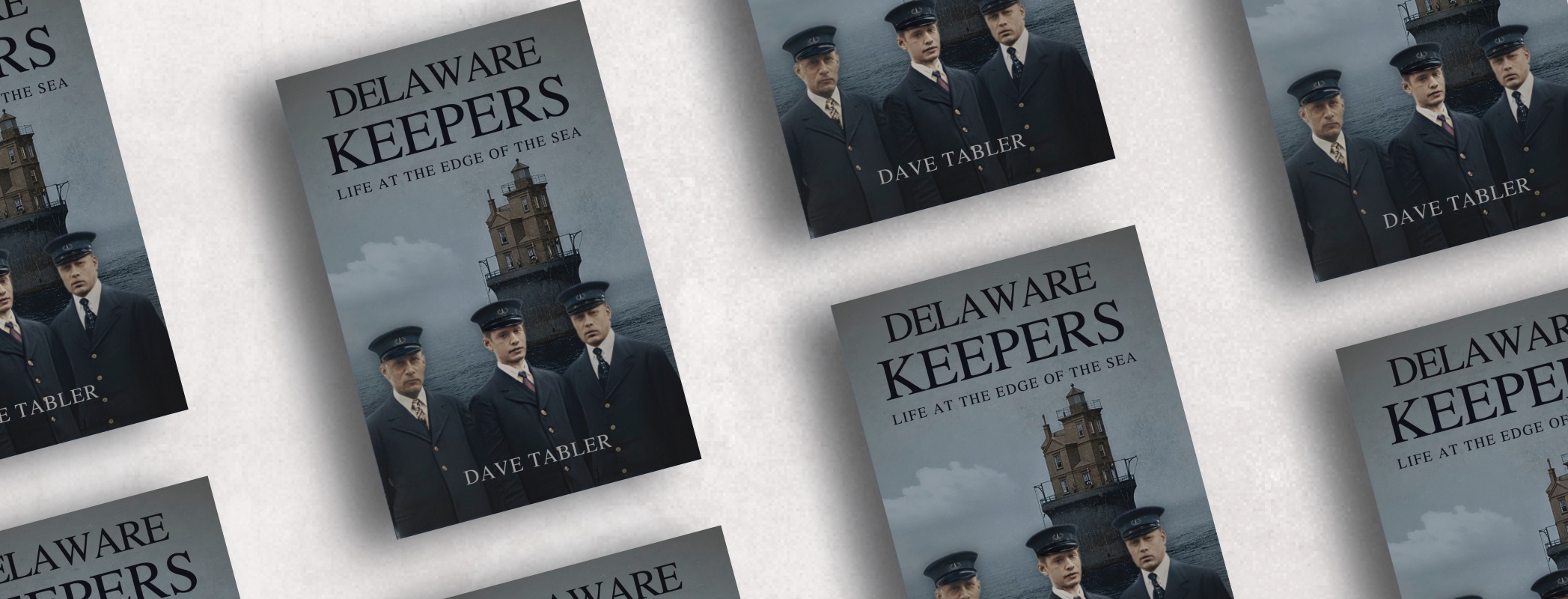

Delaware Keepers - Dave Tabler - Delaware Author

Delaware Keepers

Life at the Edge of the Sea
Released June 1, 2026
BookCollections

For more than 170 years, Delaware’s lighthouse keepers guarded one of the most dangerous coastlines in America. Their lives unfolded far from the spotlight, yet their work shaped maritime safety, coastal communities, and generations of families who lived at the edge of the sea.

Delaware Keepers: Life at the Edge of the Sea tells the largely untold story of these men and women—from the first keeper appointed in 1769 to the quiet end of human watchkeeping in the mid-twentieth century. Drawing on newspapers, government records, congressional testimony, and family histories, the book reveals lighthouse keepers not as lonely eccentrics or tragic figures, but as skilled federal employees whose lives blended technical responsibility, civic duty, and family endurance.

The story begins at Cape Henlopen during the colonial era, when keepers worked under primitive conditions amid political upheaval. During the Revolutionary War, Elizabeth Dickerson reportedly burned the lighthouse rather than allow it to guide British ships. In the early republic, keepers like Abraham Hargis pleaded with President Thomas Jefferson for relief from isolation and financial hardship, exposing the human cost of maintaining the nation’s coastal lights.

As lighthouse construction accelerated in the nineteenth century, so did the challenges. New technologies, inadequate training, and bureaucratic neglect left many keepers struggling. Reform came in 1852 with the creation of the U.S. Lighthouse Board, which professionalized the service and reshaped daily life at the stations. The Civil War tested that system, while producing a generation of keepers—often war veterans—who elevated the role’s public standing.

Contrary to popular myth, most keepers lived stable lives rooted in family and community. They raised children, joined churches and civic groups, and served for decades at the same stations. When tragedy struck, it stemmed from specific circumstances, not inevitable madness. The book replaces legend with lived reality.

Many keepers became local leaders. George W. Duncan organized bands and baseball teams while tending the Port Penn Range Lights. Harry E. Spencer fought through Delaware’s worst recorded snowstorm to reach his post. Irvin S. Lynch raised nine children at the isolated Mahon River Light while conducting rescues, including saving survivors from a wrecked barge during the Great Depression. Others repeatedly risked their lives to save strangers along Delaware’s coast.

The book also gives voice to lighthouse families. Hannah Hill’s 1950 congressional testimony reveals decades of sacrifice—dragging boats across ice, losing children at remote stations, and keeping lights burning alone during illness—offering a rare account of life beyond official records.

The final chapters follow the profession’s disappearance as automation replaced human watchfulness and the Lighthouse Service merged into the Coast Guard in 1939. Abandoned stations were dismantled, their materials scattered, and much of Delaware’s lighthouse heritage nearly erased. Preservation efforts emerged only decades later, led by descendants, educators, and local advocates determined to save both structures and stories.

The lights that still stand along Delaware’s coast now guide memory rather than ships. Delaware Keepers restores the people behind those lights—revealing a forgotten chapter of American history shaped by service, responsibility, and quiet heroism in times of storm and darkness.

Added to Delaware Division of Libraries

I’m pleased to share that Delaware’s Keepers has been added to Dave Tabler’s author page on the Delaware Division of Libraries website. It’s an honor to see the book included alongside my other works and made easily discoverable to readers, researchers, and history enthusiasts across the state.
Click Here to Explore Dave’s Books
LibGuides DBB DEKeepers

More to Know

Editorial Reviews

Read the full review US Review

“This is a book about how lighthouse keeping emerged as a profession, matured into a respected federal career, and then vanished entirely.”

This title reveals the inspiring history of Delaware’s lighthouses and the men and women who served as keepers, assistants, and mechanicians of the flames and automated lights that guided ships along Delaware’s dangerous, shifting shoals and powerful tides. Well researched and written with a deep regard for the subject matter, the book wends its way through nearly two hundred years of history, from the first appointment of a keeper at Cape Henlopen Lighthouse in 1769 through the complete automation of lighthouse beacons along Delaware’s shores in the mid-twentieth century.

Delaware’s small size and compact coastline made it possible for lighthouse keepers to be an integral part of their local communities because their beacons and homes were fairly close to town even as their occupational duties kept them somewhat isolated. The author delves deeply into the human and communal aspect of these quiet but important lives, bringing the relevance of these positions into clearer focus with the descriptive skill of a consummate historian. Tabler writes: “The lighthouse keeper as a solitary, storm-battered figure seemed increasingly at odds with fragments of evidence I encountered in Delaware newspapers—keepers hosting wedding receptions, organizing concerts, running for local office.”

Quite often the men who served as keepers brought their wives and families with them, and in the early days, some families were quite large. Wives and children often learned the keepers’ routines and became unofficial, unpaid workers who substituted for the official keeper when illness and irregularities arose. Extra duties, such as intelligence gathering, were added to keepers’ routines during times of war, including the Revolutionary War and World War I, as the need to monitor enemy craft movements became paramount to national security. By the World War II era, Delaware’s lighthouse personnel were administered by the US Coast Guard, so intelligence gathering was no longer conducted by civilian keepers or their families.

Tabler juggles the intricate historical details of life along the Delaware coast with the skill of a scholar and the flair of a great storyteller. There are many compelling stories threaded throughout the text, such as the dramatic burning of the Cape Henlopen lighthouse on November 17, 1777, by Elizabeth Dickerson, the first keeper’s skilled widow who refused to aid the British with a guiding light. Perhaps this story will soon be acknowledged as equally important to US history as the well-known story of the lanterns in Boston’s Old North Church tower and the ride of Paul Revere, but until now it has been preserved only in local memory. “For a brief moment during the Revolution, the keeper’s station at Henlopen became a node in a broader resistance—part lantern, part watchtower, part signal post.”

As the world turned and changed, beacons and personnel were added along Delaware’s coastline while technology gradually changed the equipment and keepers’ duties. The human and community-based aspect of light keeping gradually fell away, but the author includes several more well-cited chapters of riveting, informative narrative that fully examines the transitions and transformations of this occupation. Readers of historical nonfiction will not only embrace this text but will likely find Tabler’s other publications on Delaware history informative and entertaining as well.

RECOMMENDED by the US Review

Tabler’s Delaware at Christmas and Delware Behaving Badly were 2026 Eric Hoffer Book Award nominees.

Book review by Kate Robinson

Review Website

Read the full review by Kirkus Review

A fascinating collection of historical vignettes about the people who kept Delaware’s lighthouses running.

Tabler offers a history of Delaware’s lighthouses and their keepers.

The latest in the author’s series of books illuminating Delaware’s history focuses on the lighthouse keepers who warned sailors away from the Delaware coast for nearly two centuries, beginning in 1769 and extending through periods of war, revolution, and civil unrest. As in his earlier books, Tabler cites an enormous array of primary sources, from local newspaper accounts to genealogies, to flesh out in great detail the stories of the men and women who took on this job for around 170 years. Throughout, Tabler stresses that the stereotypical image of a lighthouse keeper held by most Americans, that of “the bearded hermit tending his lamp through howling storms, slowly losing his grip on sanity in the endless haze,” is completely wrong. The characters he describes in these pages are generally well-balanced family members and integral participants in their communities. The stories range from the 1760s (John and Elizabeth Dickerson kept the first beacons at Delaware’s Cape Henlopen) to the advent of lighthouse automation in the 1940s to the tales of men like William H. Johnson, the last keeper of the Christiana Lighthouse, whose duties by 1939 had been reduced to “little more than polishing lenses and keeping equipment in condition.” Each era and story is carefully grounded in footnoted sources, although none of those sources approach the comprehensive sweep of Tabler’s own accounts.

Far more so than in many of his earlier books, the author strikes a melancholy note in this work, frequently reminding readers that the story he’s telling comes to a sordid and ignominious ending. By his reckoning, Delaware has done a fairly shoddy job of honoring the history of these beacons that saved so many mariners’ lives over the years. Old lighthouses are neglected or torn down, and their accompanying residential structures are demolished in a casual erasure that Tabler views as an important loss: “As the towers fell and the houses were stripped for lumber, something more intangible was disappearing alongside them: the very idea of the lighthouse keeper as a meaningful figure in American life.” This somber note is effectively counterbalanced by the sheer abundance of fascinating historical detail the author provides, adroitly reminding readers that a good storyteller can make even obscure details fascinating. James H. Bell, for example, had been a transitional figure before his death at age 80 in 1906, the first of a new generation of lighthouse keepers who were far more prominent public figures. “His voice, captured in print and preserved,” Tabler writes, “bridges the quiet flame of the lantern with the wider world it illuminated.” The book’s many black-and-white photos inspire the same fascination as the stories they illustrate; Tabler brings the photos to vivid life, including copious details about the evolution of the types of equipment involved. Tabler is doing for Delaware’s regional history what Edward Rowe Snow did for Massachusetts-based lore a generation ago, retelling familiar stories and uncovering new ones to celebrate the ordinary people who have kept history moving forward. He keeps his narrative tempo smoothly balanced between broader history and personal detail, making this niche bit of history utterly gripping reading.

A fascinating collection of historical vignettes about the people who kept Delaware’s lighthouses running.

Explore the official Review Page

Read the full review by BookLife

Tabler (Delaware Behaving Badly) draws from extensive research sources—family stories passed on through generations, government archives, newspapers, and more—to craft a detailed account of Delaware’s lighthouse keepers, starting with John Dickerson’s “experimental role” in 1769 through the early 1940s, when human-staffed stations became replaced by the age of automation. “These men were ordinary—sometimes broken, sometimes steady—trying to make sense of difficult work in remote places,” he writes of these unique workers—men, women, and families who sacrificed physical comforts, security, and connection in the name of “quiet heroism [and] the steady execution of duty.”

History buffs will relish the extensive detail Tabler includes, from timelines of key events to changing construction processes to the evolving role of the keepers themselves: initially a labor-intensive, poorly paid position, it eventually grew into a more disciplined profession, bringing with it new levels of oversight that often placed keepers in precarious positions, “caught between experimental technologies, power struggles, and an overburdened bureaucracy.” He also covers the advances made in the light itself—from the early 19th-century Winslow Lewis lamp to experimental gas lighting to automatic electrical controls. Accompanying those riveting particulars are reproduced black and white photographs of individual keepers, their dwellings, and the often-rough terrain surrounding the lighthouses themselves.

Tabler’s attention to the keepers’ dedication and important roles in community life threads throughout his writing, reminding readers that “some responsibilities transcend convenience, and that some lights must never be allowed to go out.” Moments of repetitive, fragmented prose that focus more on telling readers what things are not rather than what they are detract from that powerful message—“not as a relic, but as a resource”; “not of isolation but of duty”; “Repurposed, not revered” are just a few examples—but this is still an impactful portrait of a historically crucial trade—one that deserves to be documented, studied, and celebrated.

Takeaway: Riveting portrait of Delaware lighthouse keepers through time.

Comparable Titles: Elinor De Wire’s Guardians of the Lights, Donald Graham’s Keepers of the Light.

Read the Full Review

Read the full review by Midwest Book Review

Delaware Keepers: Life at the Edge of the Sea
Dave Tabler (Author)
Regina Higgins (Editor)
Independently Published
979-8992166767, $36.99, HC, 224pp

Synopsis:
For more than 170 years, Delaware’s lighthouse keepers guarded one of the most dangerous coastlines in America. Their lives unfolded far from the spotlight, yet their work shaped maritime safety, coastal communities, and generations of families who lived at the edge of the sea.

With the publication of Delaware Keepers: Life at the Edge of the Sea, author Dave Tabler tells the largely untold story of these men and women—from the first keeper appointed in 1769 to the quiet end of human watchkeeping in the mid-twentieth century. Drawing on newspapers, government records, congressional testimony, and family histories, the book reveals lighthouse keepers not as lonely eccentrics or tragic figures, but as skilled federal employees whose lives blended technical responsibility, civic duty, and family endurance.

The story begins at Cape Henlopen during the colonial era, when keepers worked under primitive conditions amid political upheaval. During the Revolutionary War, Elizabeth Dickerson reportedly burned the lighthouse rather than allow it to guide British ships. In the early republic, keepers like Abraham Hargis pleaded with President Thomas Jefferson for relief from isolation and financial hardship, exposing the human cost of maintaining the nation’s coastal lights.

As lighthouse construction accelerated in the nineteenth century, so did the challenges. New technologies, inadequate training, and bureaucratic neglect left many keepers struggling. Reform came in 1852 with the creation of the U.S. Lighthouse Board, which professionalized the service and reshaped daily life at the stations. The Civil War tested that system, while producing a generation of keepers—often war veterans—who elevated the role’s public standing.

Contrary to the popular myth of light keeper isolation, most keepers lived stable lives rooted in family and community. They raised children, joined churches and civic groups, and served for decades at the same stations. When tragedy struck, it stemmed from specific circumstances, not inevitable madness. Delaware Keepers: Life at the Edge of the Sea replaces legend with lived reality.

This maritime history also gives voice to lighthouse families. Hannah Hill’s 1950 congressional testimony reveals decades of sacrifice—dragging boats across ice, losing children at remote stations, and keeping lights burning alone during illness—offering a rare account of life beyond official records.

The final chapters follow the profession’s disappearance as automation replaced human watchfulness and the Lighthouse Service merged into the Coast Guard in 1939. Abandoned stations were dismantled, their materials scattered, and much of Delaware’s lighthouse heritage nearly erased. Preservation efforts emerged only decades later, led by descendants, educators, and local advocates determined to save both structures and stories.

Critique:
A seminal, meticulous, comprehensive, and simply fascinating maritime history, Delaware Keepers: Life at the Edge of the Sea by Dave Tabler (and with the editorial assistance of Regina Higgins), is a unique and unreservedly recommended pick for personal, professional, community, and college/university library American Maritime History collections and supplemental curriculum studies lists. Exceptionally well written, organized and presented, it should be noted for students, academia, and readers with an interest in lighthouses and their history that this hardcover edition is also readily available in a digital book format (Kindle, $9.99).

Editorial Note #1:
Dave Tabler is a Delaware-focused author using his University of Maryland degrees in art history and photojournalism to examine and explore the first state’s rich history and publish works of his findings. He also manages AppalachianHistory.net.

Editorial Note #2:
Regina Higgins is a writer and editor in Chapel Hill with more than twenty years of experience working with writers, publishers, universities, and nonprofits. Along the way, she has been a college teacher, a university administrator, and an outreach director. But most of all, she’s a worker with words and a gifted storyteller.